Showing posts with label Tank Car. Show all posts

Sunday, March 9, 2025

Prototype Inspiration - Chemicals and The Paper Industry

 The Northwest has a long history of forest products production, from timber and plywood to paper, providing many carloads of revenue for the railroads serving this region. Pulp and paper mills have always held a great fascination for me, particularly the large integrated mills which started with logs or raw wood chips and carried out every step of transforming the wood into finished products.  I’ve been fortunate to spend a good part of my career selling equipment to these mills while learning their processes and history.

Some of the first pulp and paper mills in the Northwest were established in the late 1800’s and early 20th century. Many expanded and diversified over time to become very large manufacturing enterprises. What many do not realize is that the pulp and paper manufacturing process requires a great deal of chemistry, as well as producing some useful chemical byproducts.  

1954 CZ Magazine Ad Discussing Industrial Chemical Production

While the first paper making process was mechanical, chemical pulping followed, producing a wider range of more useful and attractive paper products. There are several basic processes to break down wood fiber into pulp that can be used to make paper of many types.  These processes can require caustic, acids, lime, bleaching agents, mineral slurries and other specialized chemicals. Additional chemicals are used to provide specific properties for finished paper products, such as brightening agents, rosin and starch for sizing, mineral slurries like clay for smoothness, even copper sulfate as a fungicidal additive (for fruit wrap), among others.

 The Kraft, or sulfate process, is the dominant method used (https://en.wikipedia.org/wiki/Kraft_process), with the sulfite process (https://en.wikipedia.org/wiki/Sulfite_process) and it’s variations not uncommon in the heyday of paper production. Here is a good basic article on papermaking chemistry: https://www.chemistryworld.com/features/the-complex-chemistry-of-making-paper/4017234.article. Other specialized methods combine temperature and pressure with chemicals or mechanical processing.  It’s not my intent to provide a treatise on papermaking, but to illustrate the range of chemicals consumed, and transported by rail, in this industry.  

At various times, liquid byproducts from pulping were commercially attractive to market as well. These included tall oil, wood alcohol, turpentine and lignin compounds. Another was vanillin, artificial vanilla, produced from lignin, refined and sold for flavoring.

All, or most, of these chemicals require tank cars, or sometimes box cars with bags or drums, for inbound and outbound loads.


The photo in the advertisement above shows an overview of the Puget Sound Pulp and Paper mill in Bellingham, Washington. A string of tank cars and the curved chemical area railroad tracks are visible in the mid foreground of the picture.  This mill is a primary inspiration for my layout modeling efforts.  During World War II it produced wood alcohol along with other chemicals, and owned a small second hand fleet of private label tank cars, apparently until the mill was sold to Georgia Pacific in 1963.  My research on these cars continues, with the goal of modeling them.

The mill received tank cars of chlorine for bleaching, sodium hydroxide and sulfuric acid for the pulping process, along with other papermaking chemicals. All of this provides opportunities to model a range of tank cars suited for these commodities. I will expand on this in subsequent posts and as my research progresses.


Wednesday, April 6, 2022

Tale of The Tardy Tank Car

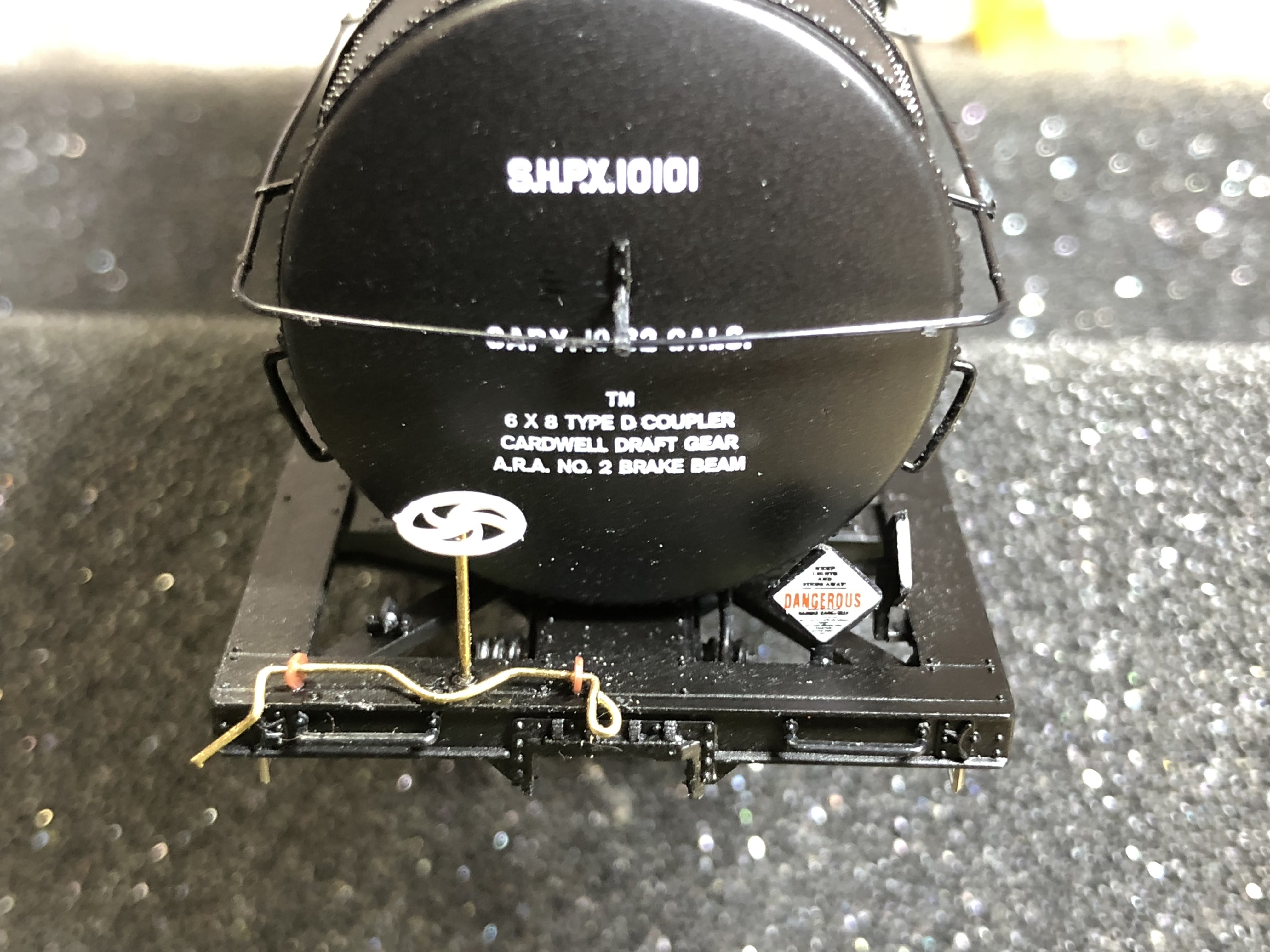
 There is a tank car on my workbench which seemed to have taken up permanent residence in a partially finished state until just recently.   I would pull it out, fiddle, ponder and slide it off to the side, having made incremental progress at best. I allowed contemplating some of the finer details to intimidate me until finally pushing through those challenges and finishing assembly last month.  Here it is now, just needing a coupler, the trucks mounted and a little touch up paint.


The model is a Proto2000 10,000 gallon Type 21 riveted tank, with nice detail and paint, including very fine printing. When I purchased it, I was taken with the binary road number 10101, and can always put  a plain black tank that could carry a variety of liquids to good use serving the mill. 

It built into a fine looking model, although there are some fiddly bits, particularly the tank band ends, and the hand rail around the tank.  These finally submitted to gel CA to help tack them in place.

While finishing the model was done at county road crew pace, I did take the opportunity to replace a few detail parts with wire and etched metal replacements for durability, and practiced my wire bending skills.

Last month I shared a wordless photo of the brake wheel end of this tank car after completing what was supposed to be the last detail.  Did you spot my mistake?

Unfortunately, in my excitement about finishing, I glued the brake staff and wheel in place with the coupler lift bar flipped back.  Due to the design of the lift bar with a curve to fit around the brake staff, it was trapped out of place 🤬.  Stepping away from the workbench, and handy implements of destruction, I calmed down and thought through how best to fix my goof. Remove the brake staff or the lift bar attachments?   I decided to remove the lift bar by cutting off the Tichy styrene eye bolts.  This then required drilling out the pin of the eyebolt left behind in the end frame so I could replace them.  I had wanted to try the Tichy eye bolts I had on hand and they do look nice.  It was also probably easier to replace those than it would have been to remove wire ones. Here is the final result.


Tichy .0125 inch phosphor bronze wire was used for the cut lever and .015 for the brake staff, with a Tichy brake wheel.  The kit styrene brake lever part was used as a template for bending the wire.  The A end lever is similar, without the curve to fit around the brake staff.  Bending the wire went well using several specialty pliers.  I have a small pair of chain nose pliers (red handle in photo below) that work well for tight curves.  The sharp angles were accomplished with Xuron 575 micro bending pliers along with their 450 tweezer nose pliers for holding (blue handles in photo below).


I also upgraded he kit provided sill steps with very fine looking etched metal ones that Yarmouth Model Works made specifically for this kit.  These add on details will get brush painted after cleaning with alcohol on a cotton swab to remove oils.


One other lesson learned was to consider replacing kit furnished styrene brake rods with brass.  I had already built the underframe per kit instructions early on and ended up breaking on of the brittle brake rods during handling in a later assembly step, so replaced one section with wire. I may end up replacing more.


All in all, a positive experience and a sense of accomplishment in getting this model out of the shop. Once painting is finished.


Wednesday, October 20, 2021

Wednesday Wanderings - Tank Car Edition

 Travel, whether for work or pleasure, can sometimes provide an opportunity to find and photograph interesting railroad subjects.  In this Wandering, I share a few tank cars that could have been in use during the period that I model, and which offer interesting details for reference in modeling.

This first tank car was located at the Marias Museum of History & Art in Shelby, MT.  My wife and I were attending the Great Northern Railroad Historical Society (GNRHS) convention held at Glacier National Park in 2010.  One of the activities offered was an all day bus tour to several locations along the BNSF (former GN) line, including a stop at this eclectic museum, which had a caboose and tank car alongside a collection of antique farming equipment.


I have not been able to determine the origin of this car, which has reporting marks USA 19049.  The other lettering was too faded to read, so I do not have many details.  The car is sitting on a very nice set of Andrews trucks and easily accessible on all sides for photos.  I won't overwhelm you with all of them, but this next photo shows an interesting lever hand brake and some of the rivet detail clearly.


Further back, my work regularly called for driving trips to Eastern Washington, including the Richland - Pasco - Kennewick Tri-Cities area, which is the location of the Department of Energy's Hanford Site, which was the Manhattan Project site that produced the majority of the plutonium used for nuclear weapons beginning in WWII and ending in 1987.  Pasco is also the location of a major rail yard that was once owned by the SP&S Railroad and which still serves the BNSF today.

Behind some warehouses that date back to the WWII era and are now an industrial park, there is a collection of vintage railroad equipment, both freight and passenger, that is openly accessed.


This welded ICC 103-W tank car built by GATC in August 1949 is one of the pieces of rolling stock there.  The stenciling notes that the tank is Saran lined, likely for corrosive chemical service of some kind.  Original reporting marks were painted over, and the number HO-10H-3686 is not one I have identified. 


This photo is a close up view of the double shelf coupler on the brake end of the car.  This type of coupler is relatively newer than the car, and is designed to prevent another car's coupling "riding" up or under the tank car coupling and possibly puncturing the tank in a derailment.  From other stenciling on this car, it appears that it may have been in use until the mid 1990's, which could explain why this coupling was retrofitted.  Note the air brake hose detail also.


Here's one last tank car view to finish off our Wandering this week, this one also taken in Pasco on the same trip in 2005.  This is a riveted car, built by AC&F in January 1941.  Unfortunately I did not get a clear picture showing the type of the car, but it has an unusual large platform around the dome.  My guess is this was added some time after the car was built, as it still has a small side platform below the dome on this side that appears to be original.  Again, it seems this car was in use into the 1990s.

Merry Christmas!