
Friday, December 31, 2021

Saturday, December 11, 2021
Drill Bit Organizer Review
I have been looking for a drill bit organizer for awhile now. As I start to build more craftsman type kits, including resin and kitbashes, the need for more, and a wider variety of , drill sizes has made me realize that my current single container for bits is inadequate. Not only is it too small but it necessitates measuring the bit diameter with calipers when a bit is changed. This was not a major issue when only using a couple of sizes that could be left in the pin vices, but it is a major inconvenience when drilling a larger variety of hole sizes. In addition, I had need of more bits to replace broken ones.

Small Bit Storage Container & Pin Vices
Another popular storage organizer is a flat plastic case with a clear sliding lid, having individual slots for each size from #61 to 80. Again, it is intended for one of each size, although the flat design is compact and easily stored in a drawer. Unfortunately, it appears this may no longer be available, at least from the sources such as Micro-Mark that I have checked.
A third organizer is a metal case with a lid and flip up holder for the bits, a miniature version of a design that has been in use many years for larger drill bits one might have in their tools at home or work. These seemed clunky and not very practical to me.
Some organize their small bits in small individual envelopes or resealable plastic bags, even plastic pill bottles.
I was searching for a solution that would store multiples of each bit size, be easily accessed, and sturdy. While looking for some good quality drill bits at Otto Frei, a jewelry supply company, I came across a 3D printed drill bit organizer and dispenser made by Nashef Designs. The design was intriguing and looked like it met my needs. Even better, Otto Frei had a bundle that included the organizer, either 5 or 10 of each bit size, and a bonus tube of cutting lubricant. I decided to purchase the "Basic Kit" with 5 of each size from #51 to 80 (150 bits total). The cutting lubricant has already been put to use in tapping holes.

BORE (tm) Drill Bit Organizer
The organizer is very cleverly designed, with 32 compartments that are labeled with the bit size. The top rotates with a distinct click between each compartment, allowing easy access to one size. Clear windows on the side provide a visual check of the compartments. This organizer holds a wider range of bits than most, from #51 to #80, with an extra compartment, and a closed position.

The resin material it is printed from seems durable, almost like a nylon. Typical for 3D printed items, there are striations or small ridges on the material that are artifacts of the printing process, although the markings for each bit size are very clean edged and easily read. The overall size may be a bit large for some at roughly 4 inches in diameter and a similar height, but I appreciate the design and storage capacity, along with the clearly indicated bit sizes. It has found a home on top of a storage bin on my workbench. The tube of lubricant fits in the center hole, keeping it handy.
One observation so far is that it can be a bit tricky to get the smallest bits out of the organizer. Because it is designed for #51 size and down, the compartments are tall and the small bits, #74-80 in particular, will sometimes catch on the striations inside the compartments or get lodged at an angle. I have found that a long pair of tweezers can be a help to grabbing one of the tiny bits and pulling it out. It may be that using a small wood stick or wire with a little piece of tape or a dab of a tacky glue might serve well also.
The organizer itself is available directly from Nashef Designs, but I recommend checking out the kit options at Otto Frei, as the price including the bits and lubricants is a good deal. I am not sure how often I will use the larger bits in this set, but even so, the pricing is good on a per bit basis.
Otto Frei has been recommended by several people in various online groups as a source of quality tools such as tweezers, pliers and cutting tools, as well as good quality high speed steel (HSS) drill bits.
Wednesday, October 20, 2021
Wednesday Wanderings - Tank Car Edition
Travel, whether for work or pleasure, can sometimes provide an opportunity to find and photograph interesting railroad subjects. In this Wandering, I share a few tank cars that could have been in use during the period that I model, and which offer interesting details for reference in modeling.
This first tank car was located at the Marias Museum of History & Art in Shelby, MT. My wife and I were attending the Great Northern Railroad Historical Society (GNRHS) convention held at Glacier National Park in 2010. One of the activities offered was an all day bus tour to several locations along the BNSF (former GN) line, including a stop at this eclectic museum, which had a caboose and tank car alongside a collection of antique farming equipment.

I have not been able to determine the origin of this car, which has reporting marks USA 19049. The other lettering was too faded to read, so I do not have many details. The car is sitting on a very nice set of Andrews trucks and easily accessible on all sides for photos. I won't overwhelm you with all of them, but this next photo shows an interesting lever hand brake and some of the rivet detail clearly.

Further back, my work regularly called for driving trips to Eastern Washington, including the Richland - Pasco - Kennewick Tri-Cities area, which is the location of the Department of Energy's Hanford Site, which was the Manhattan Project site that produced the majority of the plutonium used for nuclear weapons beginning in WWII and ending in 1987. Pasco is also the location of a major rail yard that was once owned by the SP&S Railroad and which still serves the BNSF today.
Behind some warehouses that date back to the WWII era and are now an industrial park, there is a collection of vintage railroad equipment, both freight and passenger, that is openly accessed.

This welded ICC 103-W tank car built by GATC in August 1949 is one of the pieces of rolling stock there. The stenciling notes that the tank is Saran lined, likely for corrosive chemical service of some kind. Original reporting marks were painted over, and the number HO-10H-3686 is not one I have identified.

This photo is a close up view of the double shelf coupler on the brake end of the car. This type of coupler is relatively newer than the car, and is designed to prevent another car's coupling "riding" up or under the tank car coupling and possibly puncturing the tank in a derailment. From other stenciling on this car, it appears that it may have been in use until the mid 1990's, which could explain why this coupling was retrofitted. Note the air brake hose detail also.

Here's one last tank car view to finish off our Wandering this week, this one also taken in Pasco on the same trip in 2005. This is a riveted car, built by AC&F in January 1941. Unfortunately I did not get a clear picture showing the type of the car, but it has an unusual large platform around the dome. My guess is this was added some time after the car was built, as it still has a small side platform below the dome on this side that appears to be original. Again, it seems this car was in use into the 1990s.
Tuesday, October 12, 2021
Forest Products as Traffic
Earlier I mentioned that forest products are a primary focus of my layout interests. This interest is expressed not only by my decision to model a paper mill as the central industry on the layout but also in the revenue traffic that the Olympic Peninsula Branch will carry and, necessarily, the types of freight cars needed to handle this traffic.
The inclusion of appropriate loads on various types of freight cars is a great way to increase the variety of industries served, implying their existence off "stage" as they feed traffic to the portion of the railroad modeled on the layout.
The Great Northern, like many Western railroads, depended heavily on forest products for revenue. Advertisements and other GN publicity materials illustrate this well.
This one, showing rolls of paper coming off of the finishing line at a paper mill:

1959 magazine ad - author's collection
Another discussing transport of logs and lumber, as well as promoting the railroad's efforts in developing industrial land for forest product manufacturing:

1957 magazine ad - author's collection
The boxed text in the center of this ad points out that the railroad not only transported forest products, but also consumed them for their uses, such as with ties for track. Yet another source of loads for freight cars, in this case for company service and maintenance-of-way efforts.
Going into more detail, company publications provide interesting background and examples of car loading for various wood products.

from Talking it Over, GN employee publication
March 1965 - author's collection
This short article includes very helpful detail photographs of several different plywood and lumber loads on bulkhead flat cars, which were fairly recent developments in the mid-60's. It is interesting to note that full and partially wrapped as well as unwrapped loads are all shown. This is a period where shippers were transitioning to new types of cars as well as new means of protecting their products from the elements. Previously, much finished lumber was shipped in boxcars, laboriously loaded by hand, as well as on standard flat cars, particularly rough lumber. In some cases, gondolas were also used. The desire for faster loading of larger loads, and for protection from the elements, was driving change in the railroad practices at this time.

Great Northern Goat, publicity publication
June 1965 - author's collection
This article in a monthly GN publication highlights a new customer for the railroad, a plywood mill in Montana. The bottom photograph of a box car with the iconic standing Rocky goat logo shows forklift loading of plywood into what appears to be a double door 40' car. This car would have been in my favorite glacier green color, a very signature car for the GN and one that sparked my interest in the Great Northern as a kid.
Lumber mills, plywood plants and logging are all typical of the forest product customers providing loads that were a mainstay for the GN and for my model railroad. Other loads that would be common include telephone poles on flats or gondolas, often very long and requiring idler flat cars; cedar shakes, woodchips and boxcars with paper products inside.
There is another entire set of loads and cars involved with pulp and paper mills, with a variety of tank cars handling chemicals, additives and byproducts. These are deserving of a much more detailed treatment in a future post.
As I have been building my model freight car roster, it has been helpful to look at available information like the advertising and promotional materials above, as well as period photographs, traffic reports and equipment rosters. These have shown the variety of flat cars, gondolas and box cars used for forest products by the GN and sister railroads in the Northwest.
I plan to highlight these various car types in more detail, along with their loads, in the coming months.
Wednesday, September 22, 2021
Wednesday Wanderings
A few years ago, my wife and I were walking the beautiful riverside trail along the Columbia River in Vancouver, Washington. One of the access points for the trail is next to a business park, the Columbia Business Center, that stands on what was a Kaiser shipyard during World War II. Some of the shipyard buildings still exist along with many modern commercial and industrial buildings. This area is rail served by a short spur off of the BNSF main line that also runs along the river and through downtown Vancouver.
The BNSF trackage was once the SP&S main line along the North shore of the Columbia River, and I've spent many enjoyable hours railfanning at various points along those tracks. The spur in the business park serves several businesses with occasional box cars of various commodities, covered hopper cars for a plastics manufacturer and flat car loads of steel for fabricators and some ship building.
During our visit, we happened on three neat switchers sitting idle on a siding next to one of the buildings.

photos by author

This neat little critter, CBCX-103, is a GE 25 ton industrial switcher that was built in 1942 for Kaiser Shipyard. You can see how diminutive it is, nestled up against this next locomotive.
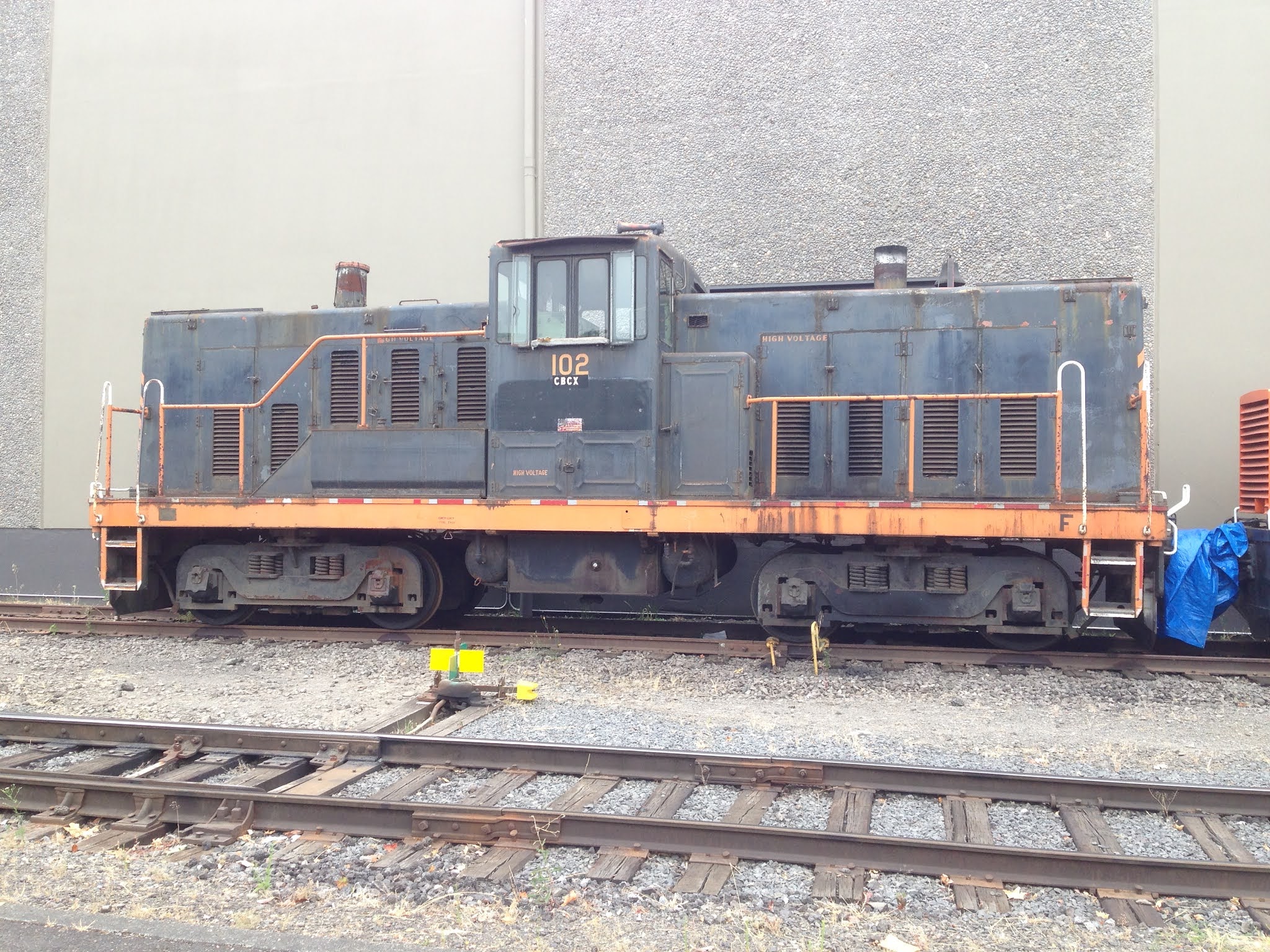
With the little 25 tonner just peeking into the photo on the right, GE 86 ton centercab CBCX-102 looks much more imposing. This loco was originally built for the Pacific Lumber Company in Eureka, California and delivered in 1956. Despite not having the spiffy orange and black paint job and logo of the other two, this is the youngest of the three. The centercab has distinctive rectangular chrome framed headlights, shown below in an oblique view that also highlights the orange safety striping.

It's great to see these workhorses still earning their keep with second, and even third, owners, although clearly not seeing daily use. Finding small railroading scenes like this is a kick and inspiration for my modeling interests as well.
Monday, August 23, 2021
Attitude Adjustment
Life gets busy - between work, family and household responsibilities, it can be a challenge to carve out time to pursue a hobby. Even when opportunity presents itself, the motivation needed to move ahead with planning and designing a layout or focus on a modeling project can seem daunting. My list of projects and accumulation of kits and other materials, at times, seems like another task rather than a relaxing activity.
These feelings around my hobby have an ebb and flow, just as they do in everyday life. When this happens, there are a couple of ways I tend to respond. If I know that the focus or motivation just isn't there, sometimes its best to do something else. Getting outside, whether in the yard, taking a neighborhood walk or out in nature, is a great restorative.

Olympic Mountains from Ocean Shores near Grays Harbor
Being outdoors has always been a part of my life growing up and living in the northwest. I find that I draw energy and inspiration from spending time outside in nature. This picture shows the coastal mountains I have hiked in most of my life as well as the beach area on the Washington coast near Grays Harbor, where my model railroad is set. I am constantly inspired by enjoying this scenery, and often return home with new energy.
On a more day to day level, I've found that there are times where I just need to make a start, focusing on one step in a modeling project or activity. Music can be a great help in getting my creative energies flowing and getting into the immediacy of what is right in front of me, which allows me to relax and become absorbed in the moment, enjoying the craft of modeling.

Bluetooth Stereo System in Layout Room
Last winter I added a small stereo system with bluetooth to my hobby space, allowing me to play favorite tunes from my iPad with decent range and sound. My musicial tastes range from '60s and '70s to contemporary rock and folk music, with a smattering of blues, funk and other genres.
My personal "music therapy" has added to my hobby enjoyment, and eased the transition from everyday cares to being absorbed in the task at hand. Invariably, I find that enjoyable time has passed, progress is made, and my mood is elevated.
Sunday, August 15, 2021
Field Research - PC 9041 GS Gondola
There is an outstanding railroad museum in Snoqualmie, Washington, just East of Seattle toward Snoqualmie Pass off of Interstate 90. In addition to a historic depot downtown and scenic weekend train rides, the museum has both indoor and outdoor exhibits, including a collection of locomotives and rolling stock.
Of great interest to me is a gondola in their collection, one of the only remaining pieces of Pacific Coast Railroad rolling stock. On a visit to the museum, I took a number of photographs of the car to capture the details. Although it sits inside of a fenced siding, I was able to view most of the car from different angles.

PC-9041 GS Drop Bottom Gondola
According to Great Northern Railroad Historical Society (GNRHS) Reference Sheet #364, the Great Northern transferred a number of older GS gondolas from GN series 76000-76249 to the PCRR around 1956 to replace worn out cars for hauling coal. This drop bottom gondola was originally built for the Great Northern in 1918 by Western Steel Car and Foundry in Illinois, as part of the GN's first purchase of General Service (GS) gondolas. After its use by the PCRR, this one went on to serve Rayonier on their logging railroad on the Olympic Peninsula, hauling gravel, and then was donated to the museum in 1986, after 68 years of use, as described on this sign next to the car.

(click to enlarge)
As you can see, the car sits outside and shows the effects of it's long years of service, but amazingly, one can still make out ghostly remnants of the large "PACIFIC COAST" billboard type lettering that the PCRR used on their gondolas.

Faint Lettering on Car Side

Lettering Diagram from Champ Decal Set HG-126
The gondola sits on trucks that have "NP" and "NORPACRY" cast on them, so at some point the original trucks apparently were changed out for these Northern Pacific solid bearing trucks, whether by one of the railroads or the museum, I am not sure. These trucks are similar to the original Bettendorf trucks that were supplied on these gondolas, based on equipment diagrams and photos in the reference sheet.

On the "B" end, it has an Ajax handbrake and you can also see the air retainer valve and the bottom dump door release mechanism. The power handbrakes were added during rebuilding in 1939, when the sides and ends were also replaced.

Brake or "B" End of PC 9041
There is no commercially available model that matches this car, one would need to accept some compromises unless you wanted to completely scratch build it. I plan to kitbash a car or two to represent these signature PCRR gondolas so being able to photograph the car and supplement my other research materials was very welcome.
Subscribe to:
Posts (Atom)

-
 Here is some background and detail on what my modeling and interests in model railroading are about. In my first post, I described my model...
 -
 I am always curious about the tools people have on their modeling workbenches, looking for ways of doing things better or with more precisi...
 -
 The Northwest has a long history of forest products production, from timber and plywood to paper, providing many carloads of revenue for th...